Work and Experience
CONSUMER & OPERATIONS
Turning a Low-Trust Job into a High-Trust Experience
Turning a Low-Trust Job into a High-Trust Experience
COMPANY
32nd
32nd
ROLE
Senior Product Designer
Senior Product Designer
TL;DR
TL;DR
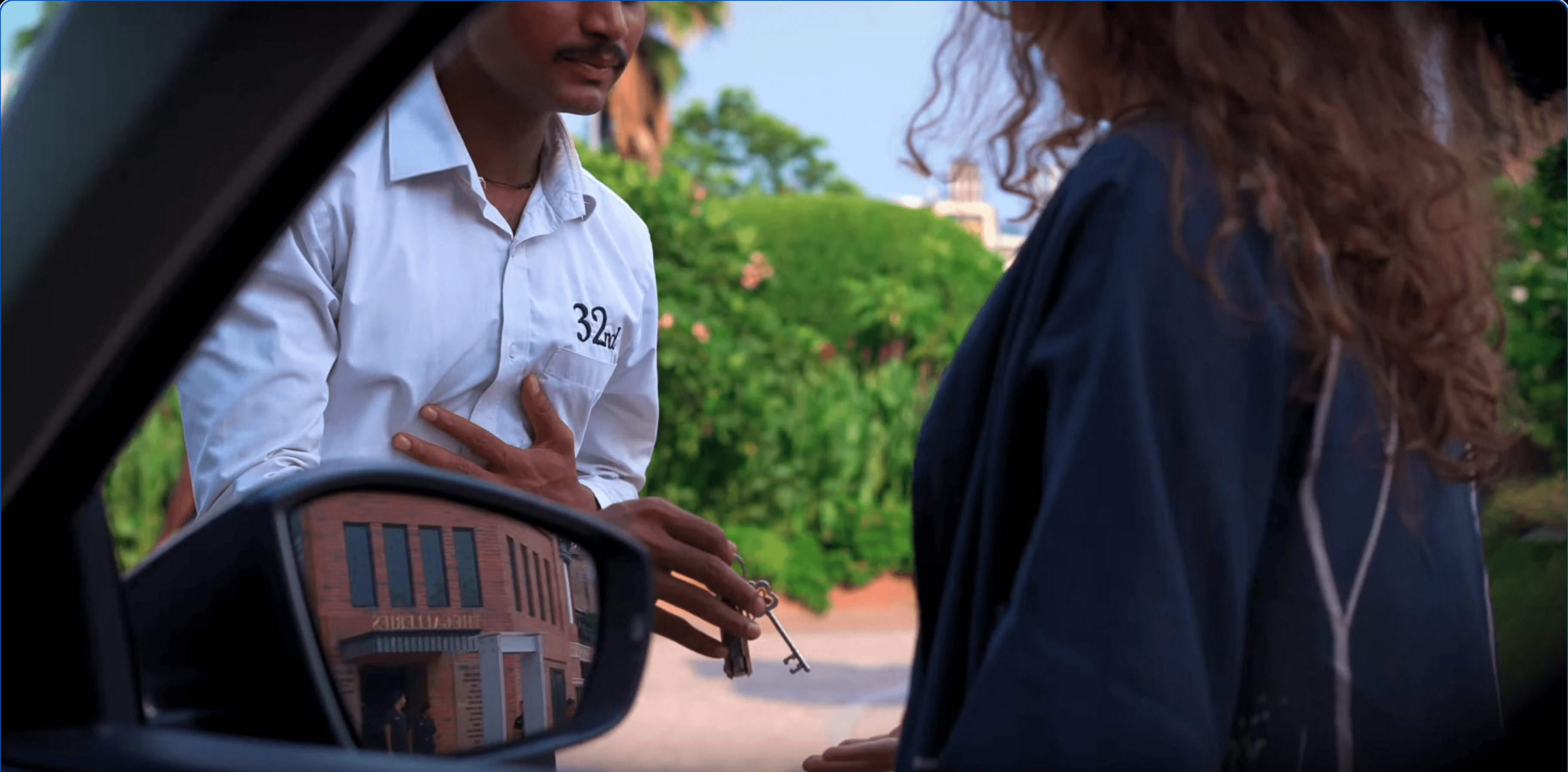
The first version of our digital valet lived as a home page widget. It showed basic status updates but did little to calm the customer’s anxiety after handing over their car. It took up prime real estate, failed to communicate critical details like PINs, tag IDs, or images, gave valets no visibility or recognition, and collapsed in disputes — with scratches still scribbled on paper tags and a buried WhatsApp helpline as the only channel for issues.
We redesigned the experience into a premium, trust-first journey. Every valet state was mapped, customers saw clear ETAs and secure handovers, and valets gained a simple inspection flow with a makers-and-checkers system to protect them from unfair blame.
Ratings surged from 4.1 to 4.6, average ratings per valet grew 3x, DIY recalls hit 96–98%, and digital payments jumped from 57% to 70%. What was once a widget became a scalable touchpoint that reassured customers, humanized valets, and set a new standard for premium service at 32nd.
The first version of our digital valet lived as a home page widget. It showed basic status updates but did little to calm the customer’s anxiety after handing over their car. It took up prime real estate, failed to communicate critical details like PINs, tag IDs, or images, gave valets no visibility or recognition, and collapsed in disputes — with scratches still scribbled on paper tags and a buried WhatsApp helpline as the only channel for issues.
We redesigned the experience into a premium, trust-first journey. Every valet state was mapped, customers saw clear ETAs and secure handovers, and valets gained a simple inspection flow with a makers-and-checkers system to protect them from unfair blame.
Ratings surged from 4.1 to 4.6, average ratings per valet grew 3x, DIY recalls hit 96–98%, and digital payments jumped from 57% to 70%. What was once a widget became a scalable touchpoint that reassured customers, humanized valets, and set a new standard for premium service at 32nd.
Setting the Scene,
Setting the Scene,
The Situation
The Situation
The Situation
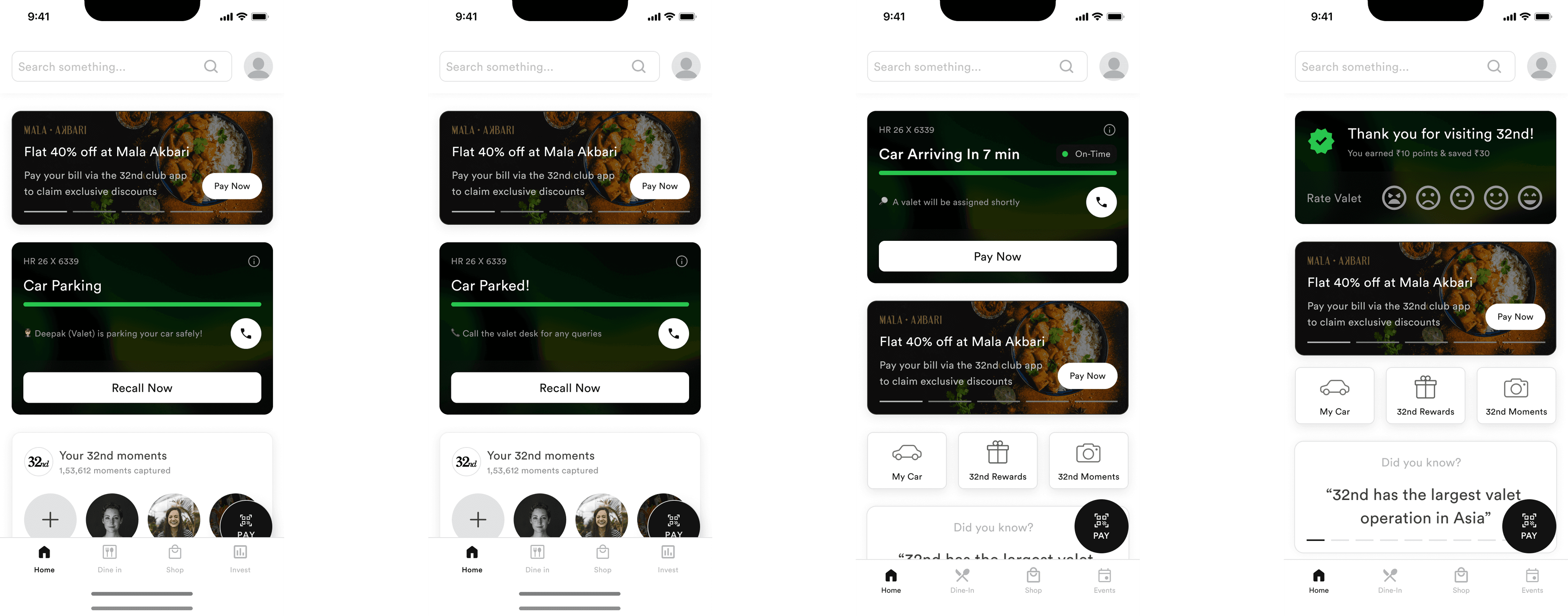
Our first digital valet lived inside a home page widget. It showed the basics — parking, parked, arriving, done — but as usage scaled, the flaws became undeniable.
It took over prime space: Nearly half the home page’s first fold was swallowed by the widget, leaving little room for promotions or discovery.
It missed critical details: No delivery PIN, no tag ID, no images at collection. Customers were left uncertain at the very moments they needed reassurance.
It kept valets invisible: A single line of text with a name was the only human touch. No ratings, no recognition, no data to power incentives.
It failed at expectation-setting: “Car arriving” without an ETA was no better than guesswork, fueling porch anxiety.
It collapsed in disputes: Scratches and dents were still scribbled on paper tags. Theft or damage claims had no digital record. Post-handover issues were buried in a WhatsApp helpline most customers never found.
What this revealed was bigger than design flaws: the system lacked trust.
Customers couldn’t fully trust that their car was safe. Valets couldn’t trust that they wouldn’t be unfairly blamed. And the business couldn’t trust the widget to scale beyond a stopgap.
If 32nd wanted valet to feel premium, it needed more than tracking — it needed an experience that built trust into every step of the journey.
Our first digital valet lived inside a home page widget. It showed the basics — parking, parked, arriving, done — but as usage scaled, the flaws became undeniable.
It took over prime space: Nearly half the home page’s first fold was swallowed by the widget, leaving little room for promotions or discovery.
It missed critical details: No delivery PIN, no tag ID, no images at collection. Customers were left uncertain at the very moments they needed reassurance.
It kept valets invisible: A single line of text with a name was the only human touch. No ratings, no recognition, no data to power incentives.
It failed at expectation-setting: “Car arriving” without an ETA was no better than guesswork, fueling porch anxiety.
It collapsed in disputes: Scratches and dents were still scribbled on paper tags. Theft or damage claims had no digital record. Post-handover issues were buried in a WhatsApp helpline most customers never found.
What this revealed was bigger than design flaws: the system lacked trust.
Customers couldn’t fully trust that their car was safe. Valets couldn’t trust that they wouldn’t be unfairly blamed. And the business couldn’t trust the widget to scale beyond a stopgap.
If 32nd wanted valet to feel premium, it needed more than tracking — it needed an experience that built trust into every step of the journey.
Cast of characters,
Cast of characters,
Customers
Customers
Hands over their car and instantly feels a gap — is it safe, when will it come back, who’s responsible? The widget gave status updates but didn’t provide reassurance or control. What they wanted was clarity, trust, and a premium experience.
Hands over their car and instantly feels a gap — is it safe, when will it come back, who’s responsible? The widget gave status updates but didn’t provide reassurance or control. What they wanted was clarity, trust, and a premium experience.
Valet
Valet
The human face of the service. Mentioned in passing inside the widget (“Deepak is parking your car”) but never truly visible. Without ratings or recognition, their work felt invisible — with no way to build accountability or dignity into the system.
The human face of the service. Mentioned in passing inside the widget (“Deepak is parking your car”) but never truly visible. Without ratings or recognition, their work felt invisible — with no way to build accountability or dignity into the system.
The Drama,
The Drama,
The Problem
The Problem
The parking widget gave customers basic status updates but failed to reassure them at the most anxious moment of their journey — handing over their car. It lacked depth (PIN, images, ETAs, dispute flow), took over valuable home screen space, and did nothing to humanize or incentivize valets.
Customers felt uncertain, and valets remained invisible.
The parking widget gave customers basic status updates but failed to reassure them at the most anxious moment of their journey — handing over their car. It lacked depth (PIN, images, ETAs, dispute flow), took over valuable home screen space, and did nothing to humanize or incentivize valets.
Customers felt uncertain, and valets remained invisible.
Hypothesis
Hypothesis
If we redesign the experience into a dedicated, premium flow that sets expectations, surfaces key information, and highlights the valet’s role, we can turn customer anxiety into reassurance, elevate the valet into a professional face of the service, and create a scalable foundation for future journeys like payments, ratings, and disputes.
If we redesign the experience into a dedicated, premium flow that sets expectations, surfaces key information, and highlights the valet’s role, we can turn customer anxiety into reassurance, elevate the valet into a professional face of the service, and create a scalable foundation for future journeys like payments, ratings, and disputes.
Research and Discovery,
Research and Discovery,
Research
Research
Talking with the valet operations manager revealed how disputes and reporting were being handled — and why the system broke down under pressure:
On Disputes
Two main types surfaced again and again:Theft — missing belongings left in the car.
Scratches & Dents — damage claims with no reliable proof.
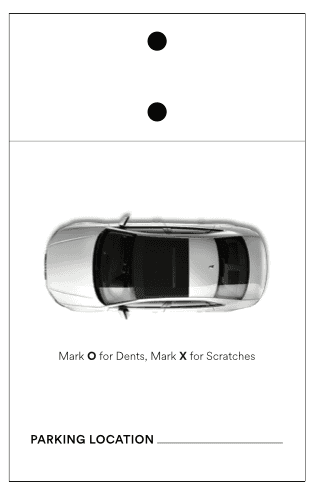
The process for scratches and dents was especially flawed. Valets had to mark circles or crosses on a paper valet tag to indicate dents and scratches. This was inefficient, inconsistent, and nearly impossible to reference later if a customer raised a claim. Both the valet and the customer were left unprotected.On Reporting Issues
After delivery, the only channel was a buried WhatsApp helpline. Most customers never found it, and even if they did, the experience felt anything but premium.
Talking with the valet operations manager revealed how disputes and reporting were being handled — and why the system broke down under pressure:
On Disputes
Two main types surfaced again and again:Theft — missing belongings left in the car.
Scratches & Dents — damage claims with no reliable proof.
The process for scratches and dents was especially flawed. Valets had to mark circles or crosses on a paper valet tag to indicate dents and scratches. This was inefficient, inconsistent, and nearly impossible to reference later if a customer raised a claim. Both the valet and the customer were left unprotected.On Reporting Issues
After delivery, the only channel was a buried WhatsApp helpline. Most customers never found it, and even if they did, the experience felt anything but premium.
Observing Controllers

Key Insight
Key Insight
The old system wasn’t just analog — it was fragile. Paper tags and hidden helplines couldn’t scale or inspire trust. A digital-first inspection and reporting flow was essential to protect both customers and valets.
The old system wasn’t just analog — it was fragile. Paper tags and hidden helplines couldn’t scale or inspire trust. A digital-first inspection and reporting flow was essential to protect both customers and valets.
Before Designing, knowing the persona
Before Designing, knowing the persona
User Persona 1
User Persona 1
Arjun Kumar — The Tech-Savvy Valet
Arjun Kumar — The Tech-Savvy Valet
Age
Age
27
27
Role
Role
Valet Driver (3 years of experience)
Valet Driver (3 years of experience)
Personality
Personality
Fast, ambitious, curious about new tools. Already uses UPI, Swiggy, and YouTube comfortably.
Fast, ambitious, curious about new tools. Already uses UPI, Swiggy, and YouTube comfortably.
Goals
Goals
Wants to maximize throughput to earn more. Craves autonomy — hates waiting for controllers.
Wants to maximize throughput to earn more. Craves autonomy — hates waiting for controllers.
Painpoints
Painpoints
Idle time kills his flow state. No way to see performance metrics or incentives.
Idle time kills his flow state. No way to see performance metrics or incentives.
User Persona 2
User Persona 2
Rakesh Sharma — The Veteran Valet
Rakesh Sharma — The Veteran Valet
Age
Age
44
44
Role
Role
Valet Driver (15+ years experience)
Valet Driver (15+ years experience)
Personality
Personality
Dependable, disciplined, less experimental with tech but confident with QR after years of using UPI. Respected by peers for experience.
Dependable, disciplined, less experimental with tech but confident with QR after years of using UPI. Respected by peers for experience.
Goals
Goals
Wants stability, clarity, and fewer disruptions in his workflow. Prefers simple, reliable systems over complex new processes.
Wants stability, clarity, and fewer disruptions in his workflow. Prefers simple, reliable systems over complex new processes.
Pain Points
Pain Points
Hates paperwork and register lookups. Doesn’t want to argue with customers when delays aren’t his fault. Needs reassurance that digital tools won’t overcomplicate his job.
Hates paperwork and register lookups. Doesn’t want to argue with customers when delays aren’t his fault. Needs reassurance that digital tools won’t overcomplicate his job.
User Persona 3
User Persona 3
Priya Mehra — The Aspirational Visitor
Priya Mehra — The Aspirational Visitor
Age
Age
34
34
Personality
Personality
Middle-class professional, visiting 32nd with her family for dinner or a weekend outing. Owns a sedan, uses UPI for payments.
Middle-class professional, visiting 32nd with her family for dinner or a weekend outing. Owns a sedan, uses UPI for payments.
Values
Values
Practical, aspirational, values premium experiences because they feel like a “treat.”
Practical, aspirational, values premium experiences because they feel like a “treat.”
Goals
Goals
Wants the valet experience to feel smooth and premium, validating her choice to come to 32nd. Needs clear reassurance that her car is safe — scratches or theft would ruin the trust.
Wants the valet experience to feel smooth and premium, validating her choice to come to 32nd. Needs clear reassurance that her car is safe — scratches or theft would ruin the trust.
Pain Points
Pain Points
Anxious about handing over keys — “will they treat my car carefully?”
Frustrated by vague waiting times.
Has no idea whom to contact if there’s an issue later.
Anxious about handing over keys — “will they treat my car carefully?”
Frustrated by vague waiting times.
Has no idea whom to contact if there’s an issue later.
User Persona 4
User Persona 4
Rohan Khanna — The Regular Premium Guest
Rohan Khanna — The Regular Premium Guest
Age
Age
45
45
Personality
Personality
Affluent business owner, frequents 32nd with clients and family. Drives a luxury SUV.
Affluent business owner, frequents 32nd with clients and family. Drives a luxury SUV.
Values
Values
Confident, status-conscious, expects seamless experiences wherever he goes.
Confident, status-conscious, expects seamless experiences wherever he goes.
Goals
Goals
Expects valet to be invisible but flawless — the car should arrive exactly when he wants it.
Values professionalism and polish — interactions should feel premium, not chaotic.
Expects valet to be invisible but flawless — the car should arrive exactly when he wants it.
Values professionalism and polish — interactions should feel premium, not chaotic.
Pain Points
Pain Points
Gets irritated by delays or unclear ETAs — hates asking twice.
Concerned about scratches on his expensive car, but doesn’t trust paper-based inspection.
Finds WhatsApp helplines beneath the level of service he expects.
Gets irritated by delays or unclear ETAs — hates asking twice.
Concerned about scratches on his expensive car, but doesn’t trust paper-based inspection.
Finds WhatsApp helplines beneath the level of service he expects.
Summary
Summary
Designing the new parking experience meant balancing the needs of both valets and customers.
On one side were the valets:
Arjun, the younger driver, wanted autonomy and speed — a system that rewarded him for higher throughput.
Rakesh, the veteran, needed simplicity and familiarity — tools that felt as intuitive as scanning a UPI code, while giving him dignity and protection.
On the other side were the customers:
Priya, the aspirational visitor, needed reassurance that her car was safe and clear communication at every step.
Rohan, the affluent regular, demanded polish, professionalism, and a service that matched the premium reputation of the campus.
These four perspectives framed our design choices. The new parking experience had to reduce anxiety for Priya, deliver polish for Rohan, empower Arjun with autonomy, and keep Rakesh confident with intuitive tools.
Designing the new parking experience meant balancing the needs of both valets and customers.
On one side were the valets:
Arjun, the younger driver, wanted autonomy and speed — a system that rewarded him for higher throughput.
Rakesh, the veteran, needed simplicity and familiarity — tools that felt as intuitive as scanning a UPI code, while giving him dignity and protection.
On the other side were the customers:
Priya, the aspirational visitor, needed reassurance that her car was safe and clear communication at every step.
Rohan, the affluent regular, demanded polish, professionalism, and a service that matched the premium reputation of the campus.
These four perspectives framed our design choices. The new parking experience had to reduce anxiety for Priya, deliver polish for Rohan, empower Arjun with autonomy, and keep Rakesh confident with intuitive tools.
Action Time,
Action Time,
Brainstorming
Brainstorming
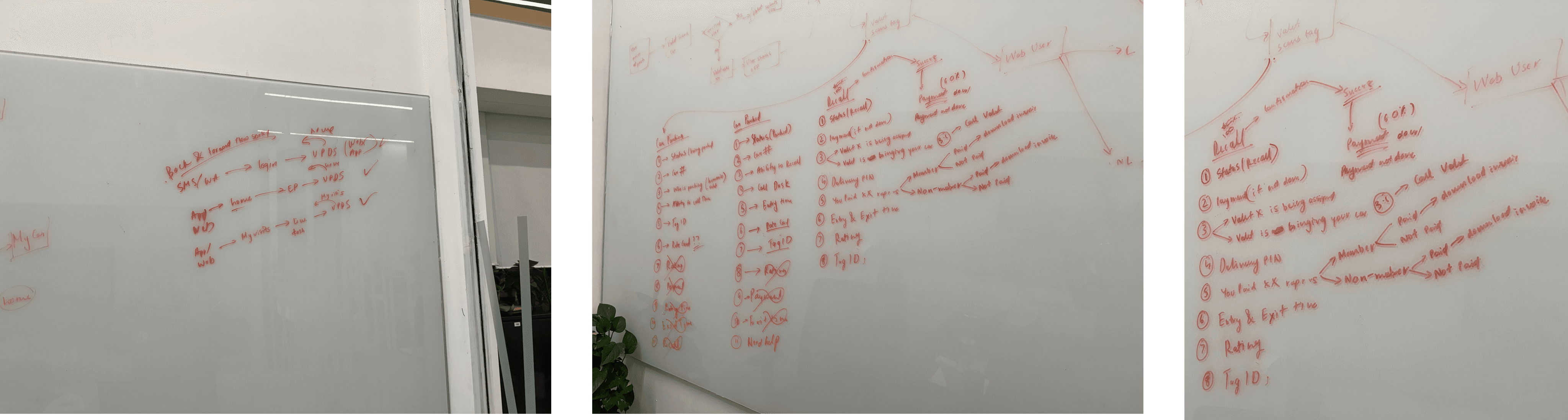
One of the first breakthroughs was realizing we needed to define every possible valet state. The old widget only showed parking or parked — far too simplistic for the complex journeys happening behind the scenes.
On the whiteboard, we mapped them all out:
Parking : Triggers as soon as the customer onboarding is completed.
Parked : Triggers when the valet marks the car as parked and ends the task.
Arriving → When a task is assigned to the Valet, split into driver assigned / not assigned or if the customer has paid / not paid
Arrived → Valet marks as arrived, it could still be if the customer has paid / not paid
Delivered → Valet asks for a security PIN sent to the customer on Whatsapp and is also available on the app, it could still be if the customer has paid / not paid
Thank You → PIN Successfully verified, customer paid.
Repark → An edge case for the customers if they are taking more time than usual to arrive, to not keep the valet holding to a particular task for too long.
This gave us the raw vocabulary to design with. Instead of abstract “status updates,” we could design a step-by-step customer journey that felt alive, transparent, and premium.
For Priya, this meant reassurance: she always knew where her car stood.
For Rohan, it meant polish: no ambiguity, no half-states.
For Arjun and Rakesh, it meant clarity: their work was tracked and credited properly.
One of the first breakthroughs was realizing we needed to define every possible valet state. The old widget only showed parking or parked — far too simplistic for the complex journeys happening behind the scenes.
On the whiteboard, we mapped them all out:
Parking : Triggers as soon as the customer onboarding is completed.
Parked : Triggers when the valet marks the car as parked and ends the task.
Arriving → When a task is assigned to the Valet, split into driver assigned / not assigned or if the customer has paid / not paid
Arrived → Valet marks as arrived, it could still be if the customer has paid / not paid
Delivered → Valet asks for a security PIN sent to the customer on Whatsapp and is also available on the app, it could still be if the customer has paid / not paid
Thank You → PIN Successfully verified, customer paid.
Repark → An edge case for the customers if they are taking more time than usual to arrive, to not keep the valet holding to a particular task for too long.
This gave us the raw vocabulary to design with. Instead of abstract “status updates,” we could design a step-by-step customer journey that felt alive, transparent, and premium.
For Priya, this meant reassurance: she always knew where her car stood.
For Rohan, it meant polish: no ambiguity, no half-states.
For Arjun and Rakesh, it meant clarity: their work was tracked and credited properly.
Brainstorming
Brainstorming
Moodboarding
Moodboarding
In parallel, we built moodboards from reference apps — delivery trackers, ride-hailing apps, order dashboards. These gave us inspiration on how to set ETAs, show live progress, and close the loop with ratings and receipts.
What emerged was clear:
The new experience had to feel as predictable as ordering food on Swiggy.
As reassuring as booking a cab on Uber.
And as premium as a high-touch hospitality service.
Only then could Priya feel reassured, Rohan feel impressed.
In parallel, we built moodboards from reference apps — delivery trackers, ride-hailing apps, order dashboards. These gave us inspiration on how to set ETAs, show live progress, and close the loop with ratings and receipts.
What emerged was clear:
The new experience had to feel as predictable as ordering food on Swiggy.
As reassuring as booking a cab on Uber.
And as premium as a high-touch hospitality service.
Only then could Priya feel reassured, Rohan feel impressed.
Brainstorming

Stakeholder Alignment
Stakeholder Alignment
When we aligned with stakeholders, one word kept surfacing: premium. The experience had to feel like Uber for clarity, Cred for polish, Zomato for transparency.
But premium didn’t just mean glossy UI — it had to mean trust and accountability. That’s where we introduced an optional “Inspection” step for valets.
Quick enough not to slow down operations.
Strong enough to create a makers-and-checkers system. If a car returned with scratches, the system traced it back to the valet who parked it — protecting the recall valet from unfair blame and giving customers digital proof.
This balance set the tone: a premium experience wasn’t just for customers, it also safeguarded valets, making the service both aspirational and fair.
When we aligned with stakeholders, one word kept surfacing: premium. The experience had to feel like Uber for clarity, Cred for polish, Zomato for transparency.
But premium didn’t just mean glossy UI — it had to mean trust and accountability. That’s where we introduced an optional “Inspection” step for valets.
Quick enough not to slow down operations.
Strong enough to create a makers-and-checkers system. If a car returned with scratches, the system traced it back to the valet who parked it — protecting the recall valet from unfair blame and giving customers digital proof.
This balance set the tone: a premium experience wasn’t just for customers, it also safeguarded valets, making the service both aspirational and fair.
Wireframes
Wireframes
A simple flow for the valet to inspect and add images of all dents and scratches instead of marking them on paper.
A simple flow for the valet to inspect and add images of all dents and scratches instead of marking them on paper.

Wireframes
Wireframes for a customer to easily raise dispute,
Wireframes for a customer to easily raise dispute,

Wireframes
For a customer, some initial iterations referring from, but they clearly weren't working.
For a customer, some initial iterations referring from, but they clearly weren't working.
Inspection for Valets
Inspection for Valets
A lightweight inspection flow : snap, upload, done. Giving valets protection and customers peace of mind without slowing operations.
A lightweight inspection flow : snap, upload, done. Giving valets protection and customers peace of mind without slowing operations.

New Customer Experience
New Customer Experience
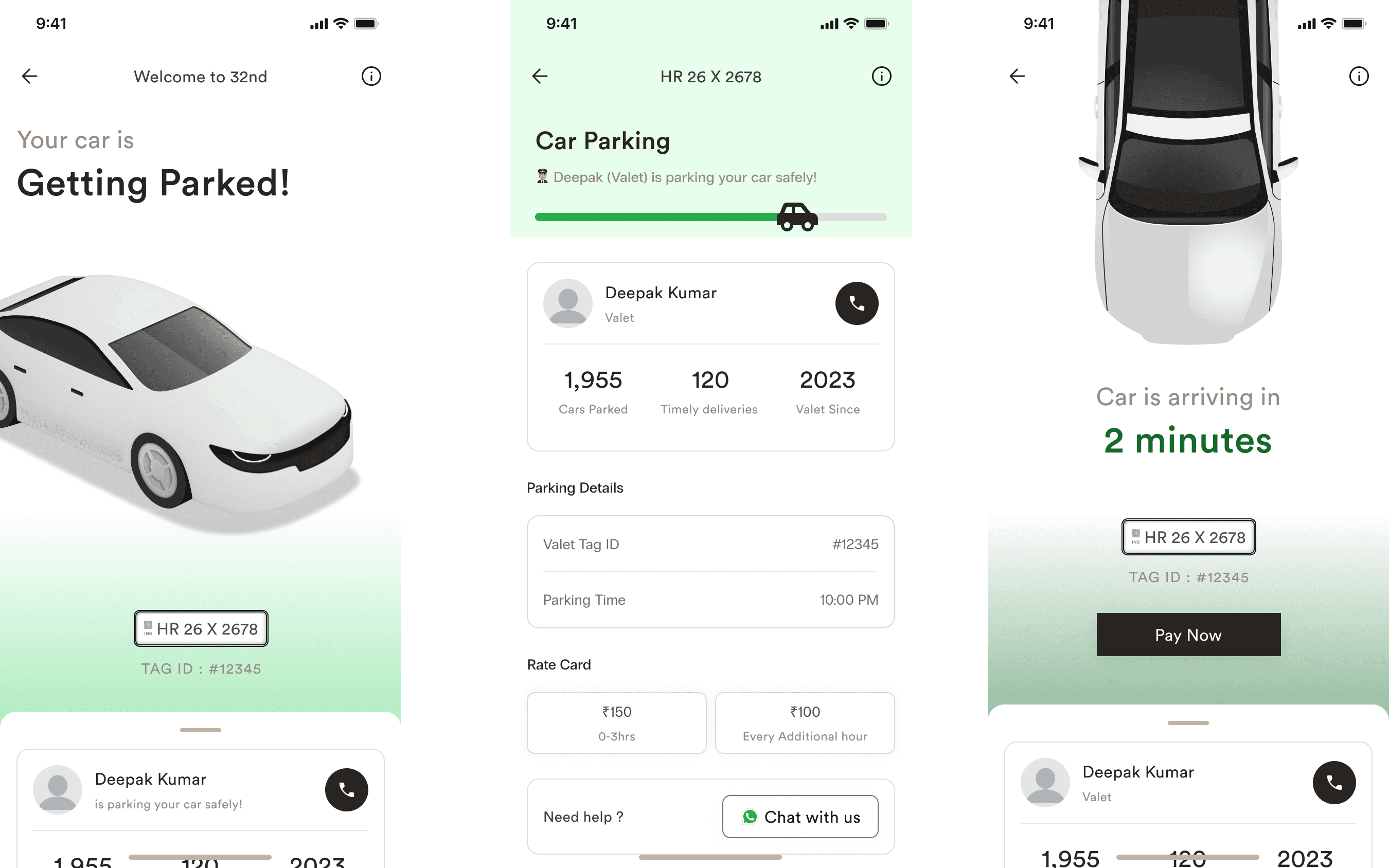
Customers get a whatsapp, which takes them to a dedicated page telling them everything about their car parking. Below is when the car moves from parking to parked.
Customers get a whatsapp, which takes them to a dedicated page telling them everything about their car parking. Below is when the car moves from parking to parked.

New Customer
Once the customer recalls, the user can select their nearest gates, the screen auto updates on every status update.
Once the customer recalls, the user can select their nearest gates, the screen auto updates on every status update.

Raising Dispute for Customers
Raising Dispute for Customers
We made sure the customers see the message to "Share PIN only when you’ve checked your car!".
We made sure the customers see the message to "Share PIN only when you’ve checked your car!".

Final Impact,
Final Impact,
Clear Impact
Clear Impact
The redesign wasn’t just cosmetic — it changed how customers and valets interacted, and the numbers prove it.
Disputes reduced, accountability increased
7 in every 100 cars used to trigger customer complaints. Many were porch-level disputes, while 2 in 100 surfaced only after customers had left the campus. By digitizing inspections and moving disputes online, we created a clear tracker that protected both customers and valets.Ratings surged
Average valet ratings jumped from 4.1 to 4.6. What used to be a trickle of 20–50 ratings per valet is now a steady stream of 100–150 per valet, giving us data to reward good service and humanize the workforce.Customer self-service adoption
DIY Recalls: up to 96–98%, consistently above the 95% benchmark.
DIY Payments: climbed from 57% to 70%, reducing dependency on cashiers and streamlining operations.
The outcome was clear: customers trusted the system more, valets gained recognition and protection, and the business unlocked efficiency at scale.
The redesign wasn’t just cosmetic — it changed how customers and valets interacted, and the numbers prove it.
Disputes reduced, accountability increased
7 in every 100 cars used to trigger customer complaints. Many were porch-level disputes, while 2 in 100 surfaced only after customers had left the campus. By digitizing inspections and moving disputes online, we created a clear tracker that protected both customers and valets.Ratings surged
Average valet ratings jumped from 4.1 to 4.6. What used to be a trickle of 20–50 ratings per valet is now a steady stream of 100–150 per valet, giving us data to reward good service and humanize the workforce.Customer self-service adoption
DIY Recalls: up to 96–98%, consistently above the 95% benchmark.
DIY Payments: climbed from 57% to 70%, reducing dependency on cashiers and streamlining operations.
The outcome was clear: customers trusted the system more, valets gained recognition and protection, and the business unlocked efficiency at scale.
Learnings
Learnings
Trust is the real product. Customers weren’t just asking for status updates, they needed constant reassurance their car was safe and traceable. Designing for trust changed everything.
Accountability protects both sides. The inspection flow wasn’t just for customers, it gave valets a digital shield against unfair blame. Premium means protecting workers too.
Humanizing the valet matters. Ratings and recognition weren’t fluff; they shifted perception. Valets went from faceless gig workers to service providers customers could evaluate and reward.
Scalability comes from self-service. DIY recalls and payments weren’t just cost-saving; they were the only way to scale without adding layers of staff.
Premium is more than polish. Stakeholders referenced Uber, Cred, Zomato for their look and feel — but the real premium came from designing clarity, control, and fairness into the journey.
Trust is the real product. Customers weren’t just asking for status updates, they needed constant reassurance their car was safe and traceable. Designing for trust changed everything.
Accountability protects both sides. The inspection flow wasn’t just for customers, it gave valets a digital shield against unfair blame. Premium means protecting workers too.
Humanizing the valet matters. Ratings and recognition weren’t fluff; they shifted perception. Valets went from faceless gig workers to service providers customers could evaluate and reward.
Scalability comes from self-service. DIY recalls and payments weren’t just cost-saving; they were the only way to scale without adding layers of staff.
Premium is more than polish. Stakeholders referenced Uber, Cred, Zomato for their look and feel — but the real premium came from designing clarity, control, and fairness into the journey.