Work and Experience

Optimizing Asia's largest

Valet Operation

Optimizing Asia's largest

Valet Operation

4 weeks

·

Mobile

Transformed a paper-heavy valet system into a seamless mobile-first experience by enabling customers to recall cars and make payments directly on their phones.

Transformed a paper-heavy valet system into a seamless mobile-first experience by enabling customers to recall cars and make payments directly on their phones.

4,00,000+

4,00,000+

Cars Parked Every Year

100+ Valets

100+ Valets

Handling the operations

4.6/5

4.6/5

Avg Experience Rating by Customer

What was the problem?

What was the problem?

Parking is often the most frustrating part of visiting a venue. At 32nd, with thousands of daily visitors, the traditional valet flow was paper-driven and dependent on physical booths, tags, and cash payments. The challenge was to transform this into a seamless, mobile-first experience that made valet not just functional but premium.

Parking is often the most frustrating part of visiting a venue. At 32nd, with thousands of daily visitors, the traditional valet flow was paper-driven and dependent on physical booths, tags, and cash payments. The challenge was to transform this into a seamless, mobile-first experience that made valet not just functional but premium.

Challenges,

Challenges,

Physical tags issued to every customer.

  • High one-time cost of recall kiosks.

  • Payments handled only through cash at staffed desks.

  • Valets required at all pickup points for assistance.

Objectives,

Objectives,

The objective was to:

  • Eliminate operational overhead (tags, booths, extra manpower).

  • Enable DIY recalls and payments directly on customer phones.

  • Improve unit economics by lifting contribution margins (CM1%).

Painpoint Discovery & Research

Conducted direct customer conversations to understand why they didn’t self-recall or pay digitally?

  • Lack of guidance

  • Poor app discovery,

  • Reliance on physical tags.

  • On payments, customers preferred to wait for the car’s arrival, used cash, or delayed payment.

Conversations with Valets and Valet Supervisor

Conversations with Valets and Valet Supervisor

User Interviews

User Interviews

Old Customer Journey

Old Customer Journey

Old Customer Journey

We have 6 different characters

We have 6 different characters

Mapping & Ideation:

Mapping & Ideation:

Identified opportunities to replace tags with digital notifications, embed recalls into familiar channels (WhatsApp), and create payment incentives.

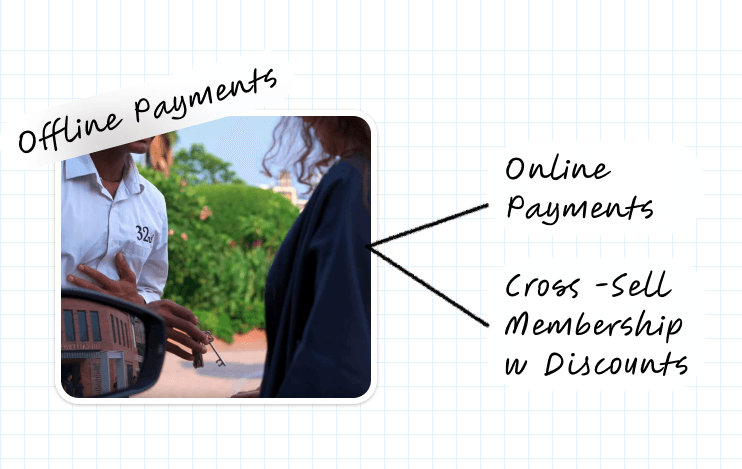
Replacing Paper with more known modes of communications

Replacing Paper with more known modes of communications

Incentivise User to promote online payments

Incentivise User to promote online payments

Valet and Parking Manager to replace all other roles

Valet and Parking Manager to replace all other roles

Proposed solution,

Proposed solution,

  • Paperless Recall: Eliminated tags for the Customers. Customers now receive a WhatsApp message after parking and can recall cars directly from their phone.

  • Real-Time Tracking: Cars can be tracked in-app, with automatic notifications when ready. Customers can use the waiting time to enjoy the venue.

  • Reduce the amount of characters: While reviewing the operations, we found that all these steps which require different characters could be replaced with just valet taking care of onboarding, parking themselves, ending the task themselves and also collecting payments.

  • DIY Payments with Incentives: Integrated 32nd Plus discounts (50% off, redeemable points) to drive digital payments, appealing to India’s price-sensitive market.

New Customer Journey

Valet, Parking Manager and Customer

Valet, Parking Manager and Customer

Final Userflows with Design

Final Userflows with Design

The valet app experience is divider into two parts:

  1. Parking flow and experience,

    1. For the Valet

    2. For the Customer

  2. Recall flow experience,

    1. For the Valet

    2. For the Customer


We will be going through the Valet Experience First, then the Customer Experience.

How a Valet initiates a parking task?

How a Valet initiates a parking task?

Userflow for a valet during parking

Userflow for a valet during parking

Valet's App during the parking flow

Valet's App during the parking flow

Onboarding a Car -> Onboarding the Customer

Onboarding a Car -> Onboarding the Customer

Scan a tag -> End Ride

Scan a tag -> End Ride

How a valet executes a recall task?

How a valet executes a recall task?

Userflow for a valet during a recall task

Userflow for a valet during a recall task

Valet's App during the recall flow

Valet's App during the recall flow

Recall Task -> Payment Done

Recall Task -> Payment Done

Customer App Experience,

Customer App Experience,

We have tried to keep customer's overall experience seamless with proper status updates.

Customer's App during the parking flow

Customer's App during the parking flow

Car Parking -> Parked

Car Parking -> Parked

The customers can recall from the app, once the recall is initiated - below is the flow.

Customer's App during the parking flow

Customer's App during the parking flow

Recall Confirmation & Payment

Recall Confirmation & Payment

Customer is asked to select a drop off point -> Further takes them to the payment flow

Customer is asked to select a drop off point -> Further takes them to the payment flow

States for a customer to track their car while their car is on the way

States for a customer to track their car while their car is on the way

Arriving -> Arrived -> Delivered -> Exit

Arriving -> Arrived -> Delivered -> Exit

Results and Learnings

Results and Learnings

Valet, often seen as a “simple” service, revealed complex edge cases and customer behaviors that required thoughtful design. The key was embedding technology invisibly into the experience so it felt natural, not forced. We did create an impact and moved numbers with this entire change:

Metric

DIY Recall Adoption

Online Payments

Manpower Cost per Car

ARPU (Average Revenue per User/Car)

Before

~30% via valet desk / kiosk

12%

Baseline 100%

Baseline

After

96% via phone

70%

–30%

+20%

  • DIY Recall adoption: From 70% using the recall kiosk and 30% from the valet desk -> 96% from their phones and 4% from the valet desk.

  • DIY Payments: Grew from 12% online payments to 70% online payments and 30% payments to the valet.

  • Reduced man power cost by 30% per car, increased ARPU by 20%.

Qualitative: Customers now able to plan their exit better as we were able to identify a touch point where we should estimated time of recall before they recall. Positive customer feedback highlighted convenience, reliability, and ease of use.

Get in touch:

Get in touch:

Create a free website with Framer, the website builder loved by startups, designers and agencies.